Uncategorized

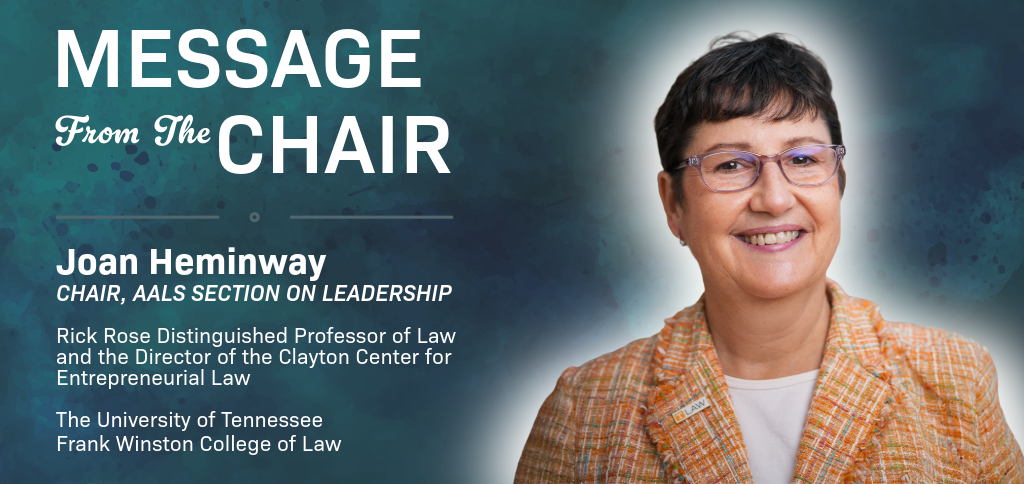
MESSAGE FROM THE CHAIR – Winter, 2025

Dear AALS Leadership Section Members:

It hardly seems possible that I am completing my year as Chair of the Section on Leadership.  It has been a great experience interacting with so many of you over the course of the year.  The ideas all of you have shared in our sessions and by email have been so useful—even inspirational at times.  Thanks so much for your many contributions and collaborations this year.  I will write about only a few here.

I look forward to continuing to work with next year’s leadership team as we transition into the 2026 membership year.  Although our elections will not formally take place until the AALS annual meeting in January, the section’s Nominations Committee—chaired by April Barton (a former section Chair) with support from fellow section Executive Committee members Tania Luma (our Chair-Elect) and Aric Short (our Secretary)—has done a masterful job organizing our Executive Committee elections in accordance with our new bylaws, approved by the AALS in the spring.

Since I last wrote, the section has offered a number of programs.  Following the March webinar on Law Students Learning to Lead through Non-Profit Board Service (about which I wrote in the spring), our webinar series continued with programs in May (Advancing Lawyer Leadership: Why Scholarship Matters, organized and hosted by Executive Committee member Leah Teague), September (Adaptive Leadership Theory & Rule of Law as Resources in Challenging Times for Law & Legal Education, organized and hosted by Tania Luma), and November (Leadership Development and Professional Responsibility, hosted by Executive Committee member Kenneth Townsend).  These forums continue to bring thoughtful, engaged ideas to the fore.

In July, in lieu of an additional webinar over the summer, Leah Teague organized and coordinated programming at the 2025 annual meeting of the Southeastern Association of Law Schools (SEALS).  The discussion group on Leadership Development to Equip Lawyers for Success, Service, and Significance (moderated by Leah Teague) was quite lively.  Although I had to miss them due to conflicts with other programs, I understand that the panel presentation on Teaching Civility and Civil Discourse as Leadership Development (also moderated by Leah) and the Demonstration of Professional Identity Formation Exercises (moderated by section member Jerry Organ) also stimulated much productive thought.  Thanks so much, Leah for these opportunities to share wisdom.  I hope we can organize a few programs for the 2026 SEALS annual meeting.

As I noted in my last newsletter message to you back in the spring, the Section on Leadership exists to support and promote your work on leading in and through law.  Our role as legal educators and staff members offers us the opportunity to impact current and future law leadership (through teaching, scholarship, and service) in meaningful ways at a time when it seems critical to so many of us.  Our AALS annual meeting program, Impact, Excellence, Resilience, and Professional Integrity: Educating Lawyers as Leaders, scheduled for Thursday, January 8 from 2:35 pm – 3:50 pm) focuses in on some of the related opportunities and challenges.  In a discussion moderated by Tania Luma, our invited guests—the American Bar Association’s Immediate Past President (Bill Bay), the AALS’s current President (Austen Parrish), and two Fifth Circuit U.S. appellate court judges (James Graves and Corey Wilson)—will tackle the education of principled lawyer leaders in present times. 

Please also note that our section business meeting is that morning (Thursday morning) from 7:30 am to 8:00 am.  Our nominations committee has finalized a great set of nominees for election at the meeting.  You should have received a separate communication on the elections through the listserv.  If not, please contact me or another member of the section’s executive committee, and we will get that to you (and help to track down why you may not have received the initial message).

In addition, we are privileged to cosponsor a program at the 2026 AALS annual meeting (Doing Well-Being Without Losing Your Mind: An Interdisciplinary Approach to Law Student, Faculty, and Staff Well-Being) with the Section on Balance & Well-Being in Legal Education.  That program is scheduled for 1:00 pm to 2:15 pm on Wednesday, January 7.  As a wellness advocate and practitioner, I was grateful for the reach-out from the leadership of the Section on Balance and Well-Being requesting our support for this program.

Please remember that you can access significant amounts of information about the section (and about other matters relevant to section members) on the section’s webpage on the AALS website.  For example, as many of you prepare for a new semester of teaching, I will take the opportunity to remind you that our section’s webpage offers access to syllabi for leadership courses, upcoming and past (recorded) webinars hosted by the section, and prior editions of this newsletter. The section’s webpage also includes a link to our section’s Bylaws and a subpage listing the names of and contact information for members of the section’s leadership. We do hope you will continue to reach out to us with your ideas for programming and resources. 

I feel truly privileged to have had the opportunity to lead the Section on Leadership this past year.  The journey has been rewarding, and I am inspired to continue it with all of you into and through the 2026 AALS membership year.  In the interim, enjoy the holiday season.  I hope to see many of you in New Orleans in January.

Best regards,

Joan

Uncategorized

MESSAGE FROM THE CHAIR – Summer, 2025

Dear AALS Leadership Section Members,

It is certainly an interesting time to be researching, writing, and teaching in the law leadership area. The value of our academic endeavors as members of this section is clear. Whether our interests lie in work that touches on government, private enterprise, or individual rights and responsibilities, there is much to say and do.

The Section on Leadership exists to support and promote your work on leading in and through law. Our section’s presence on the AALS website includes information that may be valuable to your work. For example, our webpage can direct you to syllabi for leadership courses, upcoming and past (recorded) webinars hosted by the section, and prior editions of this newsletter. The section’s webpage also includes the names and contact information for members of the section leadership, which will be growing this year due to recently adopted bylaw changes that were approved by the AALS earlier this year. We hope you will contact any of us on matters of mutual interest and that you will let us know about other useful resources we can provide to section members.

The section has been active over the past nine months. It seems like forever ago now, but we had a fascinating and productive panel discussion at the 2025 AALS annual meeting in January on The Courageous Intersection of Leadership Education, Professional Responsibility, and Professional Identity Formation(recording available through the link). I had the privilege of moderating the discussion, which featured luminaries in law leadership, including Lee Fisher, Jerry Organ, Jennifer L. Rosato Perea, Aric Short, and Kellye Testy. There were so many great questions and comments from the floor! We did not have time to cover them all. I hope we will be able to get some of those engaged audience members to write newsletter columns for us or participate in (or even just suggest topics for) webinars in the coming months.

Early in March, the section hosted a webinar in which Elsbeth Magilton, a Lecturer and the Director of Externships at the University of Nebraska College of Law, shared her work in involving students with non-profit boards. You can find out more about the webinar, Law Students Learning to Lead through Non-Profit Board Service, by clicking on the link. A recording is also available from the linked page. Among other things, Elsbeth talks about the evolution of her non-profit leadership program, which in and of itself is an enlightening part of the webinar. I am grateful to my Tennessee Law colleague Beth Ford for organizing and moderating the discussion with Elsbeth.

At the end of March, the Wake Forest University School of Law and Program for Leadership and Character hosted the second major law leadership event during the 2024-25 academic year, a Leadership and Character in the Law Conference. Section executive committee member Kenneth Townsend and his team at Wake Forest Law organized a masterful program that involved section leadership and members as well as others. The section was a partner in that effort. The conference echoed and built on the discussion group that Kenneth and his colleague Ben Rigney organized for the 2025 AALS annual meeting on Developing Courageous Leaders: Trailblazing and Diverse Approaches to Leadership Education for Law Students

And all of this followed on the October 2024 law leadership symposium hosted by the Institute for Professional Leadership at The University of Tennessee College of Law: Lighting the Way for 10 Years: A Symposium on Leadership in Law and Lawyering. I am again grateful to Beth Ford for leading the charge in organizing that event, which was also planned and executed in collaboration with the section. A special, peer-edited edition of the Tennessee Journal of Law and Policy will be published later in the year that features work related to the symposium, which celebrated the Institute for Professional Leadership’s tenth anniversary. 

I remain inspired by Tennessee Law’s commitment to leadership education. We have a new director of the Institute for Professional Leadership starting with us this summer, former Memphis Law dean Kate Schaffzin, and we are adding a new leadership course to the institute’s curriculum this fall, Lawyering and Social Change, being taught by our dean, Lonnie Brown. I likely will have more to say about all of that in future communications.

With this issue of the newsletter, the section says goodbye and thanks to our immediate past chair, Lee Fisher. Lee, the outgoing dean at the Cleveland State University College of Law and a former Ohio Lieutenant Governor and Attorney General, has been a wonderfully giving and welcoming leader for the section and for lawyer leadership education. However, he now moves on to new challenges outside legal education as he takes on the presidency at Baldwin Wallace University. We wish him well.

We also are grateful for the executive committee service of Martin Brinkley (dean at the University of North Carolina School of Law) and Kellye Testy (AALS executive director and CEO), both of whom rotated off the executive committee in January. Martin and I had some quality time together organizing a webinar for the section back in the summer of 2023 focusing on adjunct and full-time faculty collaborations on leadership curriculum and course design, and Kellye and I work in intersecting business law and leadership spaces and have known each other for almost 25 years, by my calculation (yet neither of us looks a day older somehow!). I will miss their fellowship on the executive committee, but they continue to be influential in law leadership through their institutional leadership in legal education.

AALS President Austen Parrish, Dean and Chancellor’s Professor of Law at the UC Irvine School of Law, has called us to embrace the following theme for his year in leading our profession: Impact. Excellence. Resilience. The Enduring Contributions of Legal Education. He desires to celebrate what all of us have been doing and continue to accomplish. In articulating his thoughts on this theme, he notes that law schools “have broadened their missions to try to equip the current generation with the skills and mindsets they need to succeed and live fulfilling lives.”  Legal education’s embrace of leadership instruction and training has been a part of this expansion. We are planning a program for the 2026 AALS annual meeting consistent with President Parrish’s theme.

Leading—and leading change—is what we do as lawyers and law school instructors. Our students are the future of our profession. I appreciate all that all of you are doing to forward leadership education in law schools. In a time of rapid and dramatic institutional change, our leadership in the classroom, in our writing, and in our service to the profession and other communities is more important than ever. Please use the section as a resource in your work as we all navigate the evolving circumstances in which law is practiced and learned.

Best regards,

Joan

Uncategorized

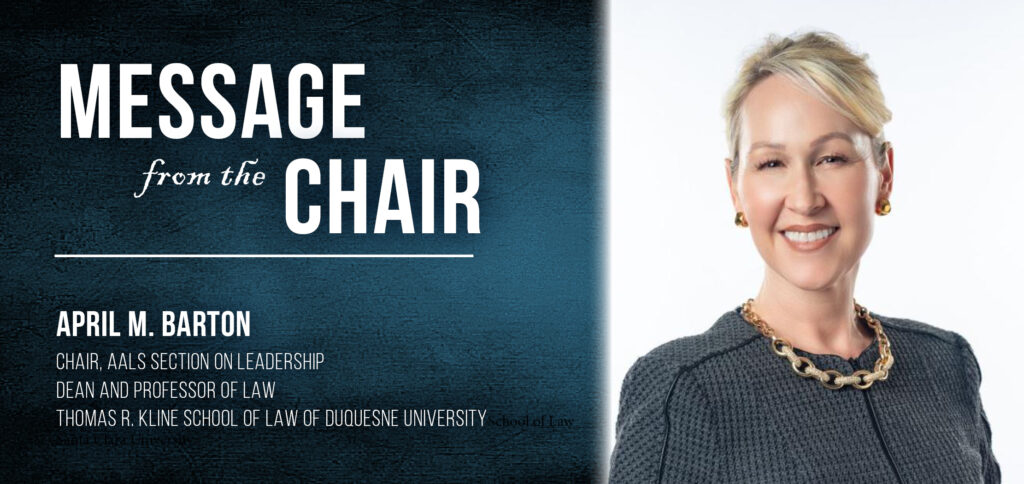
MESSAGE FROM THE CHAIR – Summer, 2023

Dear AALS Leadership Section Members,

AALS President, Mark Alexander, has challenged us to embrace this year’s theme of Defending Democracy.  “We have a special role to play in saving our democracy from the very real dangers that threaten us and our country.  [O]ur democracy is the lifeblood of a free and fair society and … is worth being defended with action and resolve.”

How does this theme relate to our AALS Leadership section? 

We must educate transformational leaders who will be positioned to serve in public office and other institutions that uphold our democracy.

We are witnessing a scarcity of leadership in our government institutions, most notably in our Congress and state legislatures. I am referring to true leadership—the kind that acts with integrity, respects the rule of law, understands respectful debate, and treats others with dignity and respect. These might sound like wistful qualities of yesteryear, but these qualities are very real and necessary to a healthy democracy and must be taught and reinforced.

Lawmakers must build coalitions, even with those with whom they disagree. They must listen and act respectfully. They must understand that compromise is essential in a functioning democratic system. We need leaders who display character, create collaborative cultures, and foster inclusive environments that uplift and inspire. Most importantly, leaders must be motivated by a higher good – our democracy and those whom we serve.

As legal educators, we can help our students understand what leadership is and what it looks like in action. Our students have a keen sense of character, service, and equity and we can reinforce and explore these qualities with them, empower them to embrace their innate compassion and humility and teach leadership skills that will equip them as they move forward to defend our democracy. 

Sincerely,

April M. Barton, Chair

<>

I am grateful to our outgoing Leadership Section Chair, Dean (now President!) Garry Jenkins, for his wisdom, leadership, and collegiality. I have learned much from him and appreciate all that he has done for our Section over the years. He is a shining example of exceptional leadership and we wish him the best in his new role as President of Bates College!

I am also grateful for our AALS Leadership Section 2023 Executive Committee who are already working hard to make sure we have programming for all of our members throughout the year. 

Executive Committee Members are:

Lee Fisher, Chair-Elect
Dean, Cleveland State University College of Law
Joseph C. Hostetler-BakerHostetler Chair in Law

Martin H. Brinkley
Dean and William Rand Kenan, Jr. Distinguished Professor
University of North Carolina School of Law

Joan MacLeod Heminway
Rick Rose Distinguished Professor of Law
Interim Director, Institute for Professional Leadership
The University of Tennessee College of Law

Susan R. Jones
Professor of Clinical Law
The George Washington University Law School

Tania Luma 
Assistant Dean, Diversity, Equity & Inclusion
Clinical Professor
Loyola University Chicago School of Law

Stephen Rispoli
Assistant Dean of Student Affairs and Strategic Initiatives
Director of Innovation and Scholarship, Executive LL.M. in Litigation Management
Baylor University School of Law

Hillary A. Sale
Associate Dean for Strategy
Agnes Williams Sesquicentennial Professor of Leadership and Corporate Governance,
Professor of Management
Georgetown University

Aric K. Short
Professor of Law & Director, Professionalism and Leadership Program
Texas A&M University School of Law

Leah Witcher Jackson Teague
Associate Dean and Professor of Law
Baylor University School of Law

Kellye Y. Testy, 
President & CEO
Law School Admission Council

Uncategorized

Expanded Conversations about Professional Identity and Leadership at AALS 2023

Aric K. Short | Professor of Law & Director, Professionalism and Leadership Program
Texas A&M University School of Law

          At this year’s AALS Annual Meeting in San Diego, there was a noticeable increase in the number of presentations and panels related to professional identity formation and leadership development from prior years. This heightened attention may stem, in part, from the newly-implemented ABA Standard 303, which requires all law schools to provide students with multiple opportunities for professional identity formation and training in anti-racism and bias. But it also likely reflects an increasing recognition within the academy that the competencies and values associated with professional identity formation are critical to preparing our students for a successful and rewarding career in law.

          Below is a sampling of topics addressed by panels and presentations on professional identity formation and leadership at this year’s Annual Meeting:

  • How to effectively spread the load of providing professional identity formation opportunities across the entire law school enterprise, including faculty and staff (sponsored by the Section for Associate Deans for Academic Affairs and Research);
  • Ways to weave training on bias, cross-cultural competencies, and anti-racism into the law school curriculum (sponsored by the Section on Civil Rights);
  • Specific techniques for helping students explore and form their professional identities from orientation through their last weeks of law school (sponsored by the Sections on Balance and Well-Being in Legal Education, Academic Support, Clinical Legal Education, Student Services, and Teaching Methods);
  • Practical tools for effectively implementing anti-racism training (sponsored by the Section on Diversity, Equity, Inclusion, and Belonging Professionals);
  • Suggestions on how to move beyond diversity to equity and inclusion in law school teaching (sponsored by the Sections on Teaching Methods, Academic Support, Balance and Well-Being in Legal Education, and Minority Groups); and
  • Exploring ways that leadership training in law schools can bring about positive change in society and for the clients our students serve (sponsored by the Section on Leadership).

In addition to these formal opportunities to discuss the theory and practice of professional identity formation and leadership, there were countless informal discussions about strategies and best practices that occurred during the Annual Meeting. All of this AALS attention on Standard 303 topics aligns with the growing number of workshops, symposia, and other efforts in broader academia addressing professional identity formation and leadership.

Of particular note to section members, the Holloran Center at the University of St. Thomas School of Law is hosting a symposium/workshop later this month for authors of casebooks used in required law school classes: “Transitioning from Student to Lawyer: Infusing Professional Identity Formation into the Required Curriculum.” Over 20 authors from all four major casebook publishers are scheduled to attend and present ideas for more formally incorporating Standard 303 themes into existing courses. Be on the lookout for articles synthesizing these ideas in a forthcoming issue of the St. Thomas Law Review.   

Uncategorized

Teaching Lawyer Leadership from A Desk Chair

Joan MacLeod Heminway | Rick Rose Distinguished Professor of Law
Interim Director, Institute for Professional Leadership
The University of Tennessee College of Law

As an advocate for leadership education in law schools, I often find myself answering questions from faculty and staff colleagues at other law schools about the courses in my institution’s law leadership curriculum and the nature of our co-curricular and extracurricular programs.  I am always happy to respond to those inquiries and share syllabi, teaching materials and methods, program ideas, and more.  But in the three years that I have been administering the leadership curriculum at The University of Tennessee College of Law, I have come to see more and more clearly that some of the most effective lawyer-leader education is accomplished through one-on-one and small-group engagements with students in office hours and meetings.  My evidence is anecdotal, but my observations may resonate.  I share a few here.

Teaching leadership in these individual and small-group settings may sound like an inefficient delivery system for law school leadership instruction.  If you have that reaction, I understand.  I also initially believed that I could impact more students in more ways by teaching them about lawyer leadership in larger classes.  And that may well be true.  Accordingly, I am not here advocating abandoning lawyer leadership education in that formal, large-group instructional setting.  Providing leadership education through traditional classroom teaching provides a compelling, credible, and (in some cases) necessary foundation to personal leadership discovery and development. 

Yet, experiences I have had in working with students on leadership strengths, weaknesses, and processes have led me to open my eyes to and think more about the value of personal, customized educational settings in the teaching of lawyer leadership.  Ultimately, I have determined that significant, influential, and (yes) efficient lawyer leadership education can and does occur in smaller, less formal instructor-student interactions outside the classroom or other structured academic activity.  There is great joy in this type of teaching, which can focus in closely on the specific emergent needs of a student.  This teaching environment tends to be a bit more organic and less intimidating than others in law school leadership instruction.

There are two specific contexts in which I have found that individual or small-group lawyer leadership lessons may be particularly efficacious: in response to a non-systemic professional development crisis and in situations involving a need for specific process guidance on a pressing matter.  Lawyer leadership, as an aspect of professional identity, can be deeply personal.  Both contexts—personal professional development crises and emergent questions relating to a course of conduct—require a deeper, more individualized dive into what may typically be core topics in a foundational course on lawyers as leaders.  Said another way, these environments involve contextual, customized applications of leadership principles.

I am sure that many have had the experience of advising law students who are contemplating leaving law school or otherwise altering the course of their professional future.  Those conversations can be important settings for the teaching of lawyer leadership, including self-leadership.  Counseling and teaching in this setting often involve not only assisting the student in more precisely identifying the root of their professional angst but also linking that root cause to leadership styles, attributes (including character strengths), strategies, and tactics. 

No doubt some also may have received law student requests for guidance in overcoming resistance to change or objections to important initiatives.  Perhaps the student is facing a challenge to their work from a more senior (or otherwise important) person on a project team.  Counseling and teaching in these circumstances may engage matters of leadership process in a frontal way.  Core questions asked in these settings may include: “How do I work with others to achieve my professional or personal goals in the face of this opposition?  What steps do I take and how do I engage them?”

Teaching in these situations can be challenging, yet very rewarding.  Approaches may draw from the full breadth and depth of the educator’s experience.  As a result, a variety of instructional methods can be useful.  In some circumstances, for example, analogous narratives—storytelling involving others who have faced the same or similar quandaries—can aid in introducing a law student to approaches to consider or reject. 

Moreover, as is true in the classroom, the application of concepts discovered or tested through academic research may play a key role in both teaching and learning in these more individualized settings.  Again, many common tools in the leadership instructor’s toolkit may be employed successfully.  For instance, one can imagine the PERMA theory of well-being from positive psychology coming in handy, or one might instruct on the “feel, felt, found” method of overcoming objections or (as I have written about elsewhere) business management models for leading change.

Finally, it seems relevant to note a side benefit of thinking and talking about the teaching of lawyer leadership individually and in small groups.  That side benefit: the prospect that the informal and personal nature of the teaching may encourage more of our colleagues to think of themselves as law leadership instructors and may engage them with lawyer leadership concepts.  Student advising is part of the everyday activity of an engaged law professor (including, e.g., counseling on academic projects, course selection, and career development).  Recognition of the role these advisory encounters can have in teaching lawyer leadership and using these types of meetings as vehicles for teaching or reinforcements of building blocks for professional development allows for a natural and logical dispersion of the responsibility for leadership instruction across the law faculty.

I hope that many of you will consider focusing on teaching lawyer leadership from your desk chair in addition to teaching lawyer leadership from behind a podium.  Personalized law leadership teaching can be a rewarding and powerful experience.  It can change student lives.

Uncategorized

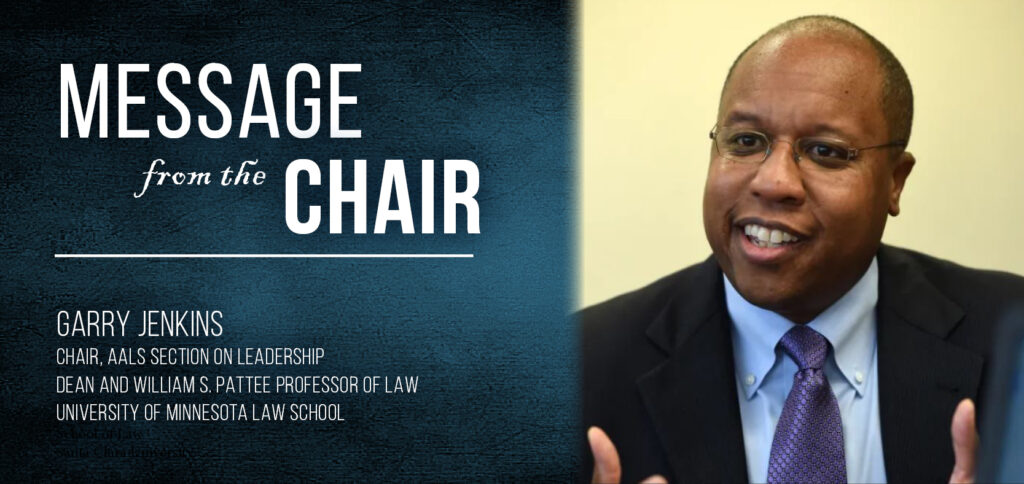
MESSAGE FROM THE CHAIR – Winter, 2022

Greetings, I hope your fall semester continues to go well—with Winter Break not too far off.  I am pleased to introduce the newest edition of our Section on Leadership newsletter and to provide a short update on the Section on Leadership and our upcoming activities, most notably the AALS Annual Meeting in January 2023.

After years of dealing with the public health crisis, this will be our first in-person meeting in three years.  I hope that many of you will make an extra effort to join us in San Diego for what will surely be a stimulating meeting and a joyous reunion. 

While we are still a relatively new Section (our inaugural section program was held in New Orleans in 2019) by AALS standards, we continue to grow and attract new members interested in advancing leadership development and leadership studies in law.  This year, as a Section, we are focused on rebuilding our community and our maintaining our positive momentum.   This year we are hosting our own session on “How Teaching Leadership Can Make a Difference” (Saturday, January 7 from 8:30-10:10 am) and co-sponsoring a session on “Incorporating Access to Justice & Pro-Bono Across the Law School Curriculum” (Thursday, January 5 from 3:00-4:40 pm).

It has been a great honor to serve as a chair of the Section and work alongside a terrific Executive Committee. 

Thank you all for your continued efforts and engagement to grow and expand the leadership field.  Our work continues to be both important and needed.  I look forward to seeing you in San Diego.

All the best,

 – Garry

Uncategorized

Leadership Can Make A Difference: Section Program at AALS Annual Meeting

Saturday, January 7, 2023 • 8:30 AM

The Section on Leadership will conduct its annual meeting and program at 8:30 a.m. to 10:10 a.m. on January 7, 2023, in San Diego, California at the AALS Annual Meeting.

Program Description:

This year’s program is “How Teaching Leadership Can Make a Difference” and will feature outstanding national leadership experts discussing how teaching leadership skills and abilities can lead to significant changes in the legal profession, governance of institutions, and others.    Those speakers are:

Dean Erwin Chermerinsky (UC Berkeley Law), Professor Angela Onwuachi-Willig (Boston University Law), Professor Hilary Sale, (Georgetown Law), Dean Garry Jenkins (Minnesota Law), and Farayi Chipungu (Harvard Kennedy School of Government).  Dean April Barton (Duquesne) will serve as moderator of the panel.  All members of the Section on Leadership are encouraged to register for the 2023 Annual Meeting and make plans to attend the Section program and the Section’s Annual Business Meeting.  For more information, please contact Dean Garry Jenkins or Dean April Barton

Uncategorized

Pop-Up Survey Results

WHAT ARE YOU WRITING?

Kathy Vinson:

I recently wrote a short article, The Great Resignation or the Great Joy in Higher Education:  Lessons from the Pandemic that discusses how leaders in higher education can help their faculty rediscover their joy at work and prevent faculty burnout, the great resignation, etc.:

https://papers.ssrn.com/sol3/papers.cfm?abstract_id=4238036

Kathleen Elliott Vinson
Professor of Legal Writing
Director of Legal Writing, Research, and Written Advocacy
Suffolk University Law School

Michael Collatrella:

Leading Law Schools: Relationships, Influence, and Negotiation 

91 University of Cincinnati Law Review No. ___ 2022

This article explores how quality relationships with one’s constituents, especially faculty, lie at the heart of successful law school leadership. Achieving meaningful institutional goals is a group endeavor, and a law school leader must have the skills and abilities to focus faculty energies and enthusiasms to a unified vison. To marshal those energies and inspire those enthusiasms, a leader must master the triumvirate leadership skills of (1) relationship building, (2) influential power, and (3) negotiation with faculty. If one is to be a successful leader in law school environments, formal or informal, one must accept the premise that the power to lead is one that law school faculty grants a person. https://papers.ssrn.com/sol3/papers.cfm?abstract_id=4086895 

Michael T. Colatrella Jr.
Professor of Law
University of the Pacific, McGeorge School of Law 

Brian Gallini:

Pandemic Leadership

University of Toledo Law Review, Vol. 52, 2021

This piece tells the story of my cross-country move to take on a first law school deanship amid a global pandemic. There is no shortage of literature about leadership outside the realm of academia. Indeed, there are a number of engaging books about leadership philosophies, styles, and guidance. But those materials are not tailored specifically to leadership roles within legal academia. Moreover, there is little scholarly literature advising deans on how to lead a law school. Unsurprisingly, perhaps, there exists even less literature advising deans on how to lead a law school during a global pandemic.

My hope for this piece is to expand the body of scholarship advising deans on how to lead a law school. This Article offers my early thoughts—first-year pandemic thoughts, to be exact—about the ways law school administrations can cultivate and maintain a strong culture focused on producing passionate and skilled lawyers. Part I tells the story of my transition from the University of Arkansas to Willamette University College of Law. Part II puts you firmly in the saddle of an administration tasked with learning to run a law school from scratch. Part III reflects on lessons learned from doing so.

https://papers.ssrn.com/sol3/papers.cfm?abstract_id=3890108

Brian Gallini
Dean & Professor of Law
Willamette University College of Law

Leah Teague:

Leadership is the answer for the changes to ABA Standards 303 and 508

Part 1: https://traininglawyersasleaders.org/2022/03/10/amendments-to-aba-standards-support-the-objectives-of-leadership-development-programming-part-1/

Part 2: https://traininglawyersasleaders.org/2022/03/15/amendments-to-aba-standards-support-the-objectives-of-leadership-development-programming-part-2/ Part 3: https://traininglawyersasleaders.org/2022/03/17/amendments-to-aba-standards-support-the-objectives-of-leadership-development-programming-part-3/

Leah Teague
Professor of Law
Baylor University School of Law

Garry Jenkins:

Leadership Evolution: The Rise of Lawyers in the C-Suite

The traditional thinking about the path to the top corporate executive leadership posts, reaching the so-called C-suite, is that it begins with earning an MBA degree. By contrast, the JD degree is thought of as one that prepares graduates for the practice of law, for government service, or for public interest advocacy. Since lawyers have historically been trained to protect clients from risk, law is not associated with senior business leadership. Yet, an evolving and accelerating trend is emerging: more lawyers are reaching or crossing over to become part of top corporate management teams. We present findings from our empirical study on corporate leadership profiles that documents a rise in the status of and opportunities for corporate lawyer-leaders and tracks major shifts in lawyers holding senior executive posts over time, thereby challenging the conventional wisdom on corporate talent management.

This Article takes the new law and leadership discourse into quantitative empirical research, and it challenges the traditional conception of the MBA degree as holding the key to a corner office. By examining the changing composition in the C-suites of Fortune 50 companies over the last thirty years, this Article documents the dramatic shift in the percentage of lawyers holding those most powerful corporate leadership posts. It then addresses the implications of these findings for those who aspire to corporate America’s highest heights, for the corporations seeking to develop new leadership talent, and for law schools inspiring and training a new generation of lawyer-leaders.

Garry W. Jenkins & Jon J. Lee, Leadership Evolution: The Rise of Lawyers in the C-Suite, 96 TULANE L. REV. 695 (2022).  

https://papers.ssrn.com/sol3/papers.cfm?abstract_id=4004219

Paul Radvany:

EXPERIENTIAL LEADERSHIP: TEACHING COLLABORATION THROUGH A SHARED LEADERSHIP MODEL by Prof. Paul Radvany

Lawyers serve as leaders throughout our society, and it is more important than ever that these leaders are effective in order to address the country’s challenges. Yet few lawyers have had any formal leadership training. Contrary to popular belief, leadership opportunities are not limited to those who serve in traditional positional leadership roles because leadership is increasingly thought of as an influence process. Thus, lawyers have many opportunities to lead, including leading their colleagues who are peers. As a result, the opportunities to lead can come early in a lawyer’s career, even in law school. This Article provides a framework for students to learn and practice leadership skills while taking a clinic. The clinic is an ideal setting to teach leadership because so much of the work is accomplished by teams in a collaborative manner. The author adopts a Shared Leadership Model of collaboration where students take turns leading and supporting each other throughout the semester. Clinical professors are ideally situated to provide leadership training as they are experts in teaching skills. As a result, by using the Shared Leadership Model, students will have the opportunity to learn and practice leadership skills in an experiential setting and be equipped to lead early in their careers.

WHAT ARE YOU READING?

Kathy Vinson:

I’m reading the following 2 books:

Unraveling Faculty Burnout and 
Global Lawyering

Brian Gallini:

Frances Frei & Anne Morriss, Unleashed

Stephen Rispoli:

Grant by Ron Chernow

Uncategorized

Review of Don Polden and Barry Posner’s new book, Leading in Law

“In Leading in Law, Barry Posner and Donald Polden make a persuasive case for why leadership studies should be included in the modern law school curriculum.  Well-organized and accessible, this book introduces law students to leadership theory and offers them practical ways to develop an important professional skill.  Law faculty will find it an effective pedagogical tool; one which prompts students to think more deeply about their own professional identity as members of the legal profession.” 

 Paula A. Monopoli, Sol & Carlyn Hubert Professor of Law, University of Maryland Carey School of Law

“This book is fantastic. It’s comprehensive, well-written, and easy to read. Great use of research findings and examples. It’s a winner!”

Doug Blaze, Dean and Art Stoinitz & Elvin E. Overton Distinguished Professor of Law, University of Tennessee College of Law

“This is an outstanding textbook by two leading scholars in the field for a law school leadership course. The greatest strength is the excellent reflection questions at the end of each chapter.”

Neil W. Hamilton, Holloran Professor of Law and Director of the Holloran Center for Ethical Leadership in the Professions
Uncategorized

MESSAGE FROM THE CHAIR – Winter, 2021

I am writing to bring the members of the Section on Leadership up to date on activities within the Section and to provide some information about the upcoming Section Annual Meeting in January 2022.  It goes without saying, that the work of the Section, like all of legal education and much of the country, has been working through the lingering effects of the pandemic, a gradual economic recovery, and continuing efforts to improve the national (indeed, international) climate for diversity, equity and inclusion.  It equally goes without saying that these challenges all require effective, ethical leadership; everywhere.  That call to action is the reason for our Section. 

The Section leadership was pleased to arrange and sponsor (through the great assistance of AALS’s Clarissa Ortiz) a “Section Social” on October 19th.  It provided a great opportunity for about 35-40 Section members to discuss their leadership classes, share information on syllabi and course coverage, and how the Section can provide additional resources to its members. 

The following paragraphs will describe the activities of the Section, its leadership group (the Executive Committee) and the excellent planning that has gone into preparations for the annual meeting program. 

I will look forward to joining members of the Section on a virtual annual program session in January of 2022.  Please contact me at [email protected] for more information. 

It has been a great honor to serve as the Chair of the Section this past year and the entire Section has benefitted from the terrific leadership of the Executive Committee. 

Thank you and…Lead On!

– Donald J. Polden

Uncategorized

Section Program at AALS Annual Meeting

The Section will hold it’s Annual Meeting program during the Annual Meeting of the AALS.  The annual meeting will be conducted remotely.  Here is the information about the Section’s program:

Leadership Education as a Component of Anti-Racist Education in Law Schools

Program Description:

Leadership education for lawyers continues to grow as more schools offer courses on leadership or integrate leadership development into existing courses and co-curricular efforts. At the same time, law schools are increasingly looking for ways to incorporate more anti-racist education into their programs. This AALS Leadership Section program will focus upon how and why faculty who teach leadership in law schools should incorporate anti-racist education into their content and methods. We will explore possibilities both for stand-alone leadership courses as well as how required courses – particularly those in professional responsibility — are an opportunity to introduce these valuable concepts to all students. The panel will provide a forum to discuss the potential of reframing our required professional responsibility courses to include introductory leadership development with an emphasis on equity and belonging and will also address effective ways of including cultural competency, equity, and belonging in independent law and leadership courses.

Moderator:

Kellye Y. Testy, President & CEO Law School Admission Council

Speakers:

April M. Barton, Dean & Professor, Duquesne University School of Law

Danielle M. Conway, Dean & Donald Farage Professor of Law, Pennsylvania State Dickinson School of Law

Garry Jenkins, Dean & William S. Pattee Professor of Law, University of Minnesota School of Law

Co-Sponsored by Clinical Legal Education, Pro-Bono & Public Service Opportunities, Professional Responsibility, Minority Groups, Law School Admission Council

Time: Sat January 8, 2022 from 3:10-4:25 p.m. EST.